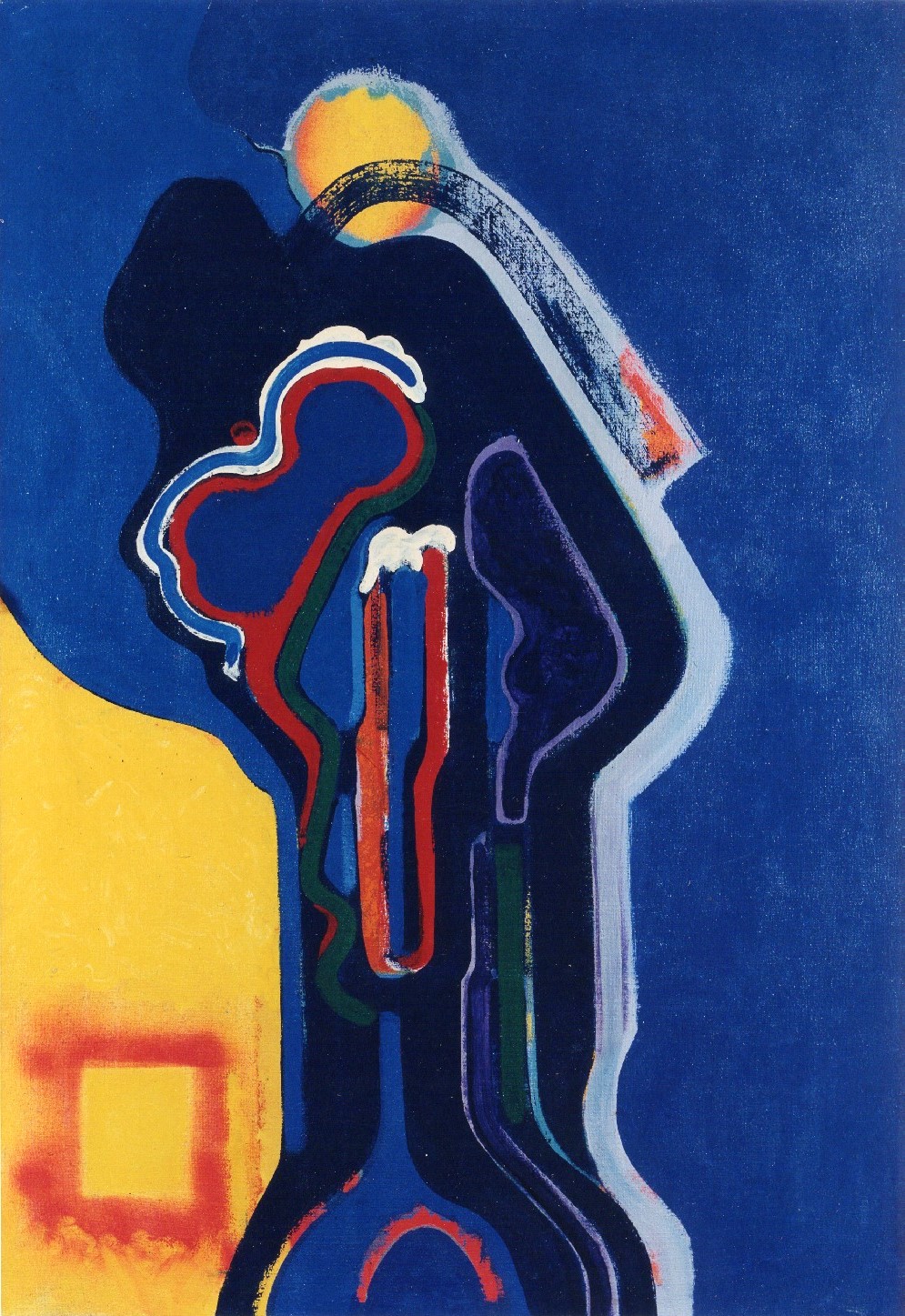
Claude Bellegarde
Parigi, 1927 - 2019
His initial painting can be placed in the context of Lyrical Abstraction, passing to Tachisme to the "Culeurs heurtées". Lucio Fontana is the first Italian collector of his works.
Although he escapes any classification in the strict sense, his initial painting can be placed in the context of Lyrical Abstraction. From 1949 he began a period of experimentation, passing from Lyrical Abstraction to Tachisme, to "Culeurs heurtées" (contrasting colors). With works of this type he presented himself for the first time at the Salons d'Octobre of 1952 and 1953. After a period of illness begins his "white period", crossed by economic difficulties overcome with the help of Père G. Vallée who offers him the direction of his art gallery just opened in Paris. From this date he began to exhibit more and more frequently, especially in private galleries. In 1955 his solo exhibition was held at Studio Facchetti with a catalogue presented by Pierre Restany. The critic will be your biggest supporter. In 1960 the Musée des Arts Décoratifs in Paris hosted his works in the exhibition "Antagonisme" while in 1965 the Galerie Schoeller included him in the exhibition "21 peintres d'aujourd'hui".
Lucio Fontana is the first Italian collector of his works. In 1957 he signed a contract with the Kramer gallery and set up an exhibition in which a monograph curated by Pierre Restany was published. At the end of the fifties the "Papier froissés" appeared: white sheets folded and glued with white paste whose sinuosity creates light reliefs. In 1955 and 1957 he participated in the Salon Comparaison, in 1956 and 1958 at the Salon des Réalités Nouvelles.
Following a trip to Morocco, around 1957-58 color reappears. These paintings are exhibited at the Galleria Apollinaire in Milan in 1959. In 1963 at the Galerie Blumenthal in Paris he presents the result of his reflections in the manifesto "For a symbolism of color" where he reveals his first "Typograms": physical portraits made through the language of color that flow into the "Color Therapy Booths"where the viewer intervenes in the projection of himself.
These researches lead him to reflect on the semantics of color as a therapy. In the following years he developed the problem of the relationship between sound and color. In 1971 the Musée d'Art Moderne de la Ville in Paris dedicated him a vast retrospective and in 1988 another anthological exhibition was organized by the Museums of Châtellerault and Niort.
Among the most recent solo exhibitions is "Planisphère" held in March-April 2007 at the Lavignes Bastille Gallery in Paris.
Museums and public collections that preserve his works:
Belgrade, Serbia, Museum of Fine Arts
Ceret, France, Musée d'Art Moderne de Ceret
Frac, Val-de-marne, France, General Council
Geneva, Switzerland, Museum of Art and History
Lille, France, Museum of Fine Arts
London, Tate Gallery
Lyon, France, Museum of Fine Arts
Marseille, France, Musée Cantini
New York, Solomon Guggenheim Museum
Paris: Centre Georges Pompidou, Musée d'Art Moderne Ville de Paris, Centre National d'Art Contemporain, Musée du Montparnasse, Bibliothèque Nationale
Perpignan, France, Musée Rigaud
Rehovot, Israel, Museum of Fine Arts
San Marino, Italy, National Gallery
Skopje, Macedonia, Museum of Fine Arts
Val-de-marne, France, Musée d'Art Contemporain du Val-de-marne
Wuppertal, Germany, Museum of Fine Arts
Bibliography:
G. Gassiot-Talabot, Bellegarde, Le musée de poche, Paris, 1970; L. Harambourg, L’Ecole de Paris, 1945-1965, Neuchâtel, Ides & Calendes, 1993
© Claude Bellegarde, by SIAE 2023
Lucio Fontana is the first Italian collector of his works. In 1957 he signed a contract with the Kramer gallery and set up an exhibition in which a monograph curated by Pierre Restany was published. At the end of the fifties the "Papier froissés" appeared: white sheets folded and glued with white paste whose sinuosity creates light reliefs. In 1955 and 1957 he participated in the Salon Comparaison, in 1956 and 1958 at the Salon des Réalités Nouvelles.
Following a trip to Morocco, around 1957-58 color reappears. These paintings are exhibited at the Galleria Apollinaire in Milan in 1959. In 1963 at the Galerie Blumenthal in Paris he presents the result of his reflections in the manifesto "For a symbolism of color" where he reveals his first "Typograms": physical portraits made through the language of color that flow into the "Color Therapy Booths"where the viewer intervenes in the projection of himself.
These researches lead him to reflect on the semantics of color as a therapy. In the following years he developed the problem of the relationship between sound and color. In 1971 the Musée d'Art Moderne de la Ville in Paris dedicated him a vast retrospective and in 1988 another anthological exhibition was organized by the Museums of Châtellerault and Niort.
Among the most recent solo exhibitions is "Planisphère" held in March-April 2007 at the Lavignes Bastille Gallery in Paris.
Museums and public collections that preserve his works:
Belgrade, Serbia, Museum of Fine Arts
Ceret, France, Musée d'Art Moderne de Ceret
Frac, Val-de-marne, France, General Council
Geneva, Switzerland, Museum of Art and History
Lille, France, Museum of Fine Arts
London, Tate Gallery
Lyon, France, Museum of Fine Arts
Marseille, France, Musée Cantini
New York, Solomon Guggenheim Museum
Paris: Centre Georges Pompidou, Musée d'Art Moderne Ville de Paris, Centre National d'Art Contemporain, Musée du Montparnasse, Bibliothèque Nationale
Perpignan, France, Musée Rigaud
Rehovot, Israel, Museum of Fine Arts
San Marino, Italy, National Gallery
Skopje, Macedonia, Museum of Fine Arts
Val-de-marne, France, Musée d'Art Contemporain du Val-de-marne
Wuppertal, Germany, Museum of Fine Arts
Bibliography:
G. Gassiot-Talabot, Bellegarde, Le musée de poche, Paris, 1970; L. Harambourg, L’Ecole de Paris, 1945-1965, Neuchâtel, Ides & Calendes, 1993
© Claude Bellegarde, by SIAE 2023